
- Create a new data frame column with specific values. Let’s say you want to add an additional column to a data frame with values generated via some external processing. You can transform the external values into a list and do the following: vals=1,2,3,4 df'vals'=vals Sort data frame by value.
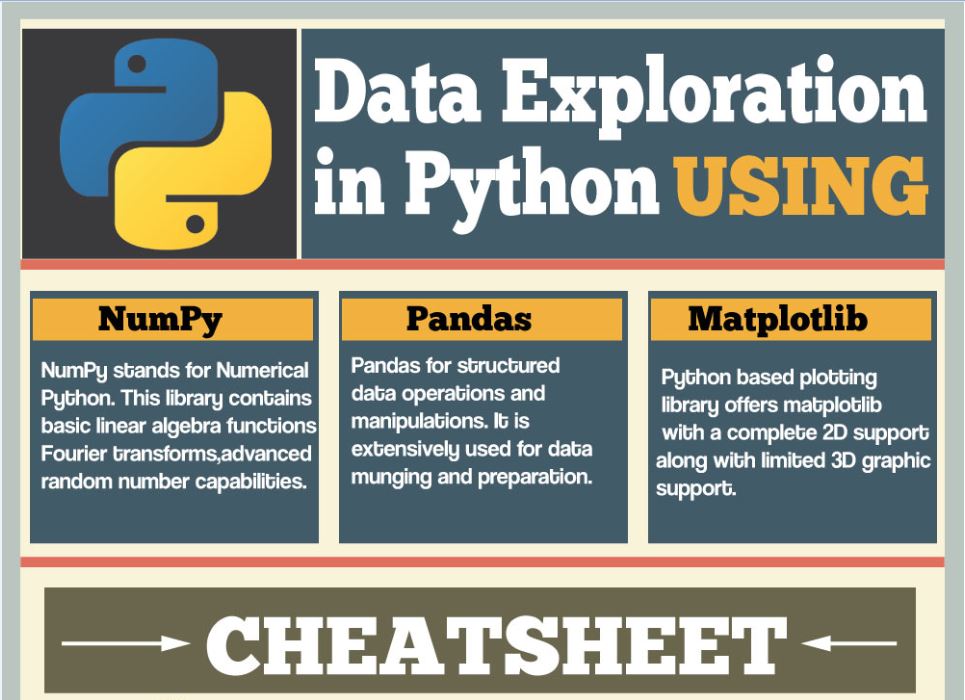
- The cheat sheet will guide you through variables and data types, Strings, Lists, to eventually land at the fundamental package for scientific computing with Python, Numpy. Below is a screenshot (the original is much easier to read.).
Python For Data Analysis Cheat Sheet
Pandas is an open-source Python library that is powerful and flexible for data analysis. If there is something you want to do with data, the chances are it will be possible in pandas. There are a vast number of possibilities within pandas, but most users find themselves using the same methods time after time. In this article, we compiled the best cheat sheets from across the web, which show you these core methods at a glance.
The primary data structure in pandas is the DataFrame used to store two-dimensional data, along with a label for each corresponding column and row. If you are familiar with Excel spreadsheets or SQL databases, you can think of the DataFrame as being the pandas equivalent. If we take a single column from a DataFrame, we have one-dimensional data. In pandas, this is called a Series. DataFrames can be created from scratch in your code, or loaded into Python from some external location, such as a CSV. This is often the first stage in any data analysis task. We can then do any number of things with our DataFrame in Pandas, including removing or editing values, filtering our data, or combining this DataFrame with another DataFrame. Each line of code in these cheat sheets lets you do something different with a DataFrame. Also, if you are coming from an Excel background, you will enjoy the performance pandas has to offer. After you get over the learning curve, you will be even more impressed with the functionality.
Whether you are already familiar with pandas and are looking for a handy reference you can print out, or you have never used pandas and are looking for a resource to help you get a feel for the library- there is a cheat sheet here for you!
1. The Most Comprehensive Cheat Sheet
This one is from the pandas guys, so it makes sense that this is a comprehensive and inclusive cheat sheet. It covers the vast majority of what most pandas users will ever need to do to a DataFrame. Have you already used pandas for a little while? And are you looking to up your game? This is your cheat sheet! However, if you are newer to pandas and this cheat sheet is a bit overwhelming, don’t worry! You definitely don’t need to understand everything in this cheat sheet to get started. Instead, check out the next cheat sheet on this list.
2. The Beginner’s Cheat Sheet
Python - Exploratory Data Analysis CheatSheet Reading a CSV file. Use header=None when the columns are not labeled in your csv file.
Dataquest is an online platform that teaches Data Science using interactive coding challenges. I love this cheat sheet they have put together. It has everything the pandas beginner needs to start using pandas right away in a friendly, neat list format. It covers the bare essentials of each stage in the data analysis process:
- Importing and exporting your data from an Excel file, CSV, HTML table or SQL database
- Cleaning your data of any empty rows, changing data formats to allow for further analysis or renaming columns
- Filtering your data or removing anomalous values
- Different ways to view the data and see it’s dimensions
- Selecting any combination of columns and rows within the DataFrame using loc and iloc
- Using the .apply method to apply a formula to a particular column in the DataFrame
- Creating summary statistics for columns in the DataFrame. This includes the median, mean and standard deviation
- Combining DataFrames
3. The Excel User’s Cheat Sheet
Ok, this isn’t quite a cheat sheet, it’s more of an entire manifesto on the pandas DataFrame! If you have a little time on your hands, this will help you get your head around some of the theory behind DataFrames. It will take you all the way from loading in your trusty CSV from Microsoft Excel to viewing your data in Jupyter and handling the basics. The article finishes off by using the DataFrame to create a histogram and bar chart. For migrating your spreadsheet work from Excel to pandas, this is a fantastic guide. It will teach you how to perform many of the Excel basics in pandas. If you are also looking for how to perform the pandas equivalent of a VLOOKUP in Excel, check out Shane’s article on the merge method.
4. The Most Beautiful Cheat Sheet
If you’re more of a visual learner, try this cheat sheet! Many common pandas tasks have intricate, color-coded illustrations showing how the operation works. On page 3, there is a fantastic section called ‘Computation with Series and DataFrames’, which provides an intuitive explanation for how DataFrames work and shows how the index is used to align data when DataFrames are combined and how element-wise operations work in contrast to operations which work on each row or column. At 8 pages long, it’s more of a booklet than a cheat sheet, but it can still make for a great resource!
5. The Best Machine Learning Cheat Sheet
Much like the other cheat sheets, there is comprehensive coverage of the pandas basic in here. So, that includes filtering, sorting, importing, exploring, and combining DataFrames. However, where this Cheat Sheet differs is that it finishes off with an excellent section on scikit-learn, Python’s machine learning library. In this section, the DataFrame is used to train a machine learning model. This cheat sheet will be perfect for anybody who is already familiar with machine learning and is transitioning from a different technology, such as R.
6. The Most Compact Cheat Sheet
Data Camp is an online platform that teaches Data Science with videos and coding exercises. They have made cheat sheets on a bunch of the most popular Python libraries, which you can also check out here. This cheat sheet nicely introduces the DataFrame, and then gives a quick overview of the basics. Unfortunately, it doesn’t provide any information on the various ways you can combine DataFrames, but it does all fit on one page and looks great. So, if you are looking to stick a pandas cheat sheet on your bedroom wall and nail home the basics, this one might be for you! The cheat sheet finishes with a small section introducing NaN values, which come from NumPy. These indicate a null value and arise when the indices of two Series don’t quite match up in this case.
7. The Best Statistics Cheat Sheet
While there aren’t any pictures to be found in this sheet, it is an incredibly detailed set of notes on the pandas DataFrame. This cheat shines with its complete section on time series and statistics. There are methods for calculating covariance, correlation, and regression here. So, if you are using pandas for some advanced statistics or any kind of scientific work, this is going to be your cheat sheet.
Where to go from here?
For just automating a few tedious tasks at work, or using pandas to replace your crashing Excel spreadsheet, everything covered in these cheat sheets should be entirely sufficient for your purposes.
If you are looking to use pandas for Data Science, then you are only going to be limited by your knowledge of statistics and probability. This is the area that most people lack when they try to enter this field. I highly recommend checking out Think Stats by Allen B Downey, which provides an introduction to statistics using Python.
For those a little more advanced, looking to do some machine learning, you will want to start taking a look at the scikit-learn library. Data Camp has a great cheat sheet for this. You will also want to pick up a linear algebra textbook to understand the theory of machine learning. For something more practical, perhaps give the famous Kaggle Titanic machine learning competition.
Learning about pandas has many uses, and can be interesting simply for its own sake. However, Python is massively in demand right now, and for that reason, it is a high-income skill. At any given time, there are thousands of people searching for somebody to solve their problems with Python. So, if you are looking to use Python to work as a freelancer, then check out the Finxter Python Freelancer Course. This provides the step by step path to go from nothing to earning a full-time income with Python in a few months, and gives you the tools to become a six-figure developer!
Related Posts
Scientifics Computing Libraries

- Pandas - Data structures & tools
- NumPy - Arrays and matrices
- SciPy - Integrals, diffierntial equations, optimization
Visualization Libraries
- Matplotlib - plots & graphs
- Seaborn - heat maps, time series, violin plots
Algorithmic Libraries
- Scikit-learn - Machine Learning, regression
- Statsmodels - Explore data, estimate statistical models, perform tests
Data Collection and Exporting
Importing csv data with no header. Omit parameter if data has a header.
Exporting csv data
Other formats and function calls
- CSV: read_csv() | to_csv()
- json: read_json() | to_json()
- Excel: read_excel() | to_excel()
- sql: read_sql() | to_sql()
Describing Data
Pandas types are generally
- object (strings) : “Hello”
- int64 : 1,2,3,4,5
- float64 : 2.12, 3.14, 5.00
- datetime64 : 2019-05-13
Check data types
Set data types
Return statistical summary
Return statistical summary with all data
Return first 10 lines of dataframe
Modifying Data
Add 1 to each row
Converting Data
Convert mpg to L/100km
Missing Data
Drop missing values where axis=0 is rows, axis=1 is columns
Replace NaN with average
Replace NaN in the column peak-rpm with 5
Or, of course simply keep the missing data in analysis!
Data Normalization
Simple feature scaling
Min-max
Z-score
Binning
Put pricing into 3 groups uniformly - low,medium, and high
One Hot Encoding
Convert categorical values to dummy variables (0 or 1)
Exploratory Data Analysis
- Descripive Statistics
- GroupBy
- Pearsons Correlation
- Correlation Heatmaps
- ANOVA
Descriptive Statistics
mean, data points, stddev, extreme values
summarize categorical data
box-plot
scatter-plot : predictor is x-axis and target is y-axis
Pandas Data Science Cheat Sheet
GroupBy
group by categories showing mean of groupings
pivot table from above grouping
heatmap from above pivot table
Pearsons Correlation
Correlation between two features
Correlation coefficient:
- close to +1: Large positive relationship
- close to -1: Large negative relationship
- close to 0: No relationship
P-value:
- Less than 0.001 : Strong certainty
- Less than 0.05 : Moderate certainty
- Less than 0.1 : Weak certainty
- Greater than 0.1 : No Certainty
coefficient and p-value
correelation heatmap
ANOVA - Analysis of Variance
F-test score: Variation between sample group means divided by variation within the sample group.
Large F implies strong correlation b/w variable categories and target variable. (i.e. Honda vs Jaguar are priced quite different)
Python Numpy Cheat Sheet Pdf
Small F implies poor correlation b/w variable categoires and target variable. (i.e. Honda vs Subaru are priced similarily)
p-value: confidence degree
ANOVA using scipy
Please enable JavaScript to view the comments powered by Disqus.comments powered by Disqus