
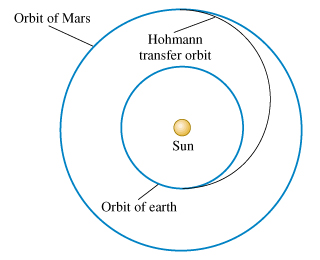
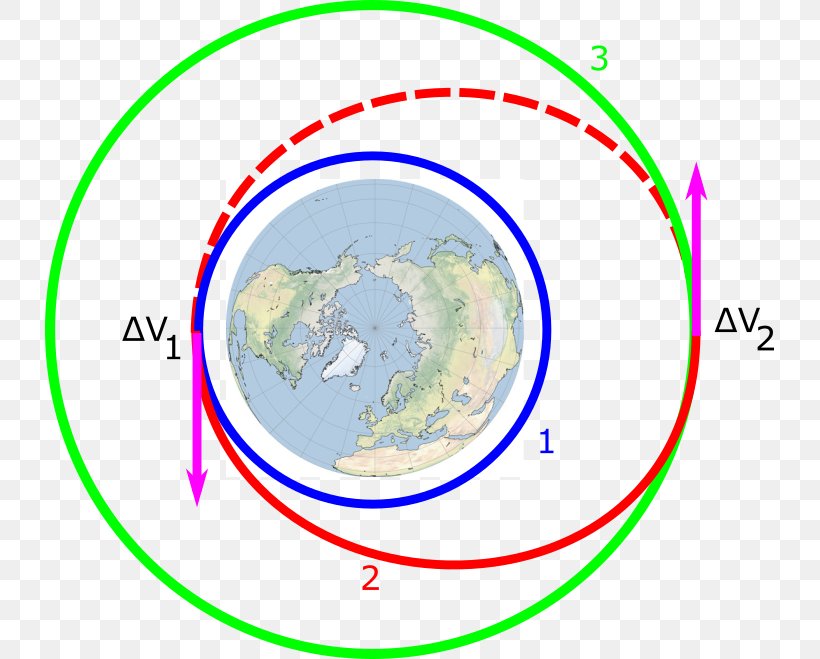
Hohmann transfers are not just for Earth orbiting spacecraft - they can also be used for interplanetary transfers. Calculating an interplanetary Hohmann transfer is very similar to calculating a Hohmann transfer for an Earth orbiting spacecraft. Hohmann transfer is commonly used to move a satellite/spacecraft from an inner (lower) circular orbit into an outer (higher) circular orbit using an elliptic transfer orbit, AKA the Hohmann transfer orbit. The geometry dictates that the Hohmann transfer orbit velocity at periapsis is in the same direction as the departure body velocity, and they are at the same radius from the Sun. So the velocity change from the departure circular orbit to the Hohmann transfer orbit is just the difference (this will be squared later, so the sign doesn't matter). The Hohmann transfer orbit is the most propellant-saving transfer orbit to Mars. When using this kind of transfer, the rover/rocket/etc. Starts from Earth when Earth and Mars are in conjunction. But now, in 2020, many Mars missions will be launched, but Earth and Mars are in opposition.
| Above is a Hohmann transfer orbit from Earth to Mars. At perihelion (the orbit's closest point to the sun), the Hohmann orbit differ's from earth's orbit by about 3 kilometers/second. At aphelion (the orbit's farthest point from the sun), the Hohmann orbit differs from Mars orbit by about 2.5 kilometers/second. |
| We zoom in on this Hohmann orbit. |
| At a different scale, the path is well approximated by a hyperbola with regard to earth. The 3 km/s difference between the sun centered Hohmann ellipse and earth's orbit is the hyperbolic excess velocity for this hyperbola. Hyperbolic excess velocity is also known as Vinfinity. |
-
What is the speed of an object in a hyperbolic orbit?
-
A naive approach is to add earth's escape velocity to Vinfinity.
This incorrect approach I call the Dr. Murphy Method.
-
 The speed of an object in earth orbit can be determined by the
vis-viva equation:
v2
 = Gm(2/r - 1/a)
-
Where
v is velocity
G is the gravitational constant
 m is earth's mass
r is the object's distance from earth's center.
a is the semi major axis of the orbit.
-
(The vis-viva equation works for elliptical orbits, as well as hyperbolic orbits).
-
The vis-viva equation can tell us the hyperbola's speed
in terms of escape velocity (vesc) and hyperbolic excess velocity (vinf)
-
v2 = Gm(2/r - 1/a)
v2 = 2Gm/r - Gm/a
Now vesc = sqrt(2Gm/r)
And vinf = sqrt(-Gm/a)
so
v2 = vesc2 + vinf2
-
Now the above looks a lot like the Pythagorean Theorem.
A memory device I use is to think of a hyperbola's velocity as
the hypotenuse of a right triangle with vesc and vinf as the legs:
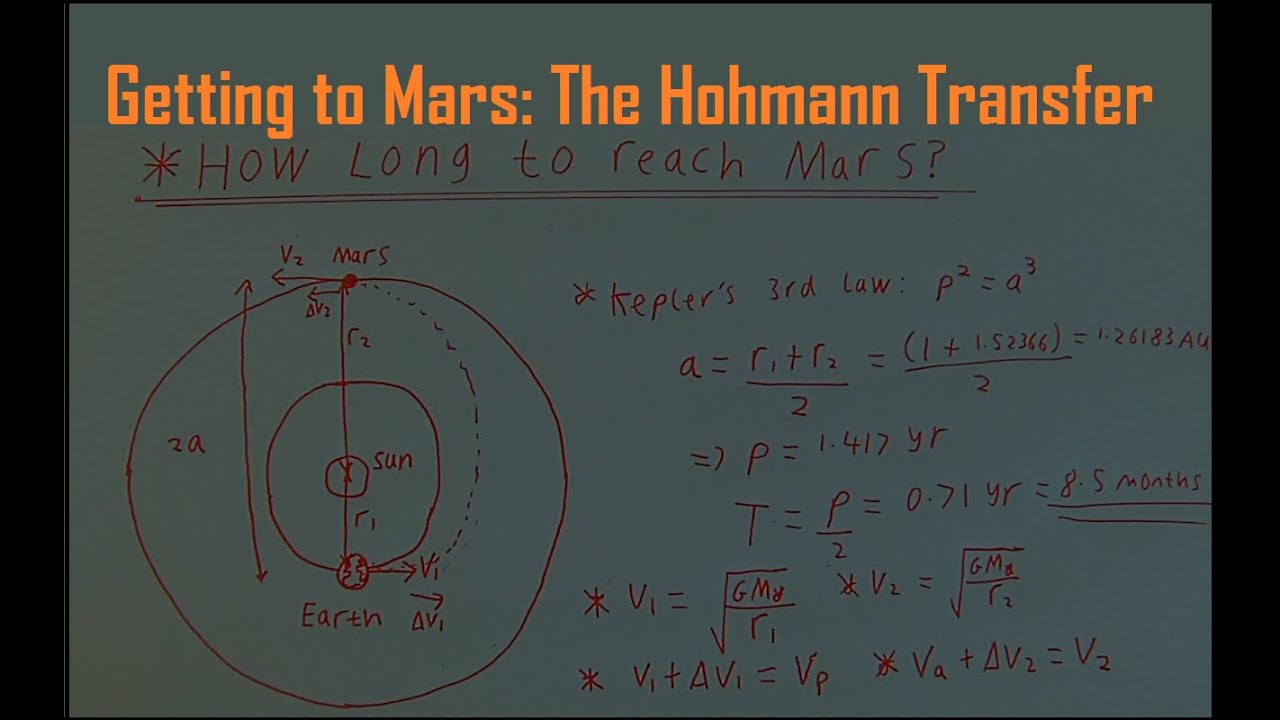
Hohmann Transfer Orbit To Jupiter
-
Earth's escape velocity near the surface is about 11 km/s.
Hohmann Transfer Orbit Pdf
The vinf for an insertion to a Mars Hohmann orbit is 3 km/s.-
The Dr. Murphy Method would tell the needed delta V is (11 + 3) km/s or 14 km/s.
It is actually sqrt(112 + 32) km/s.
sqrt(112 + 32) km/s = sqrt(121 + 9) km/s = sqrt(130) km/s which is about 11.5 km/s.